Tuesday, 17 May 2016

Reflection

The primary difficulty of this shape was its the surface of those holes are very close to each other. Unlike my previous shape which was most work on the edge of the sheet,  the major character of this skin is the holes in the center of the sheet which made me feel totally lost when I look at it. 


It was also extremely difficult to get the depth of those holes perfectly match the template, there is no very sharp-head Bossing Mallet in the workshop, so instead of finding a sharp 'hammer', I used other tools like the tapered T-Dolly which has a sharp end as a support, and this need a little bit reverse thinking because we are not allowed to use the tapered T-Dolly as a hammer. 


Overall this skin provided a totally different experience from my previous object and a greater understanding in the methods of metal shaping and how to use and combine the tools in the workshop. Although this is a individual assignment, classmates and staff are all very friendly and helpful, I am very enjoying the metal shaping in the workshop!


Friday, 13 May 2016

The results

Side

Front

Inside


Back 


Development

Below is another skin made by Alivia Wang


She made two shapes for her skin, I was going to repeat it again, but suddenly I was thinking can I combine those two shapes into one metal sheet? so it would be a more interesting shape.


1. Roughly cut the metal to this shape

2. Because the middle part suppose to bend inward, so use anything you can find to support the side part. This is the way I found to support it and use the Bossing Mallet to hit it.

3. Refine the shape by using a small hammer, all you need is patience and any support with a good angle. If your template is assembled strong enough, don't forget to use it as your support unless you cannot find a good one


Process


1. Start with a good thinking is very important for the final result, roughly mark the position of  those holes by compare to the template


 2. Use the sandbag and Bossing Mallet to create those holes one by one, because the sandbag can be adjusted, so adjust it in a good shape to support the metal sheet, then use the Bossing Mallet hardly hit the marks on your metal!


3. Compare to the template to see whether you are in a right direction or not. Here you can see that there is a big gap between the metal and template, that is because the head of the Bossing Mallet is not very sharp and the ductility of the metal cause the peripheral of the center bending as well


4. Find a flat surface and overturn the metal, use the Barrel Mallet showed above to hit the peripheral towards the center in order to narrow the hole. Keep doing this, then the gap between will become smaller than previous.  


                                                                          BEFORE


AFTER

5. However, the depth of the hole is not perfectly match the template. Hold the metal in the position against the tapered T-Dolly showed above, then hit the metal to refine the depth  


Interdisciplinary Skin

The template I found from another student(Alivia Wang) is a brick skin, it is not a simple solid rectangle shape, however, it is a type of brick with holes called hollow bricks.

Hollow bricks are lighter and easier to handle, and have thermal properties different from solid bricks, as an architecture student, I am very interested in this skin.


Below is the skin made by Alivia Wang


Monday, 25 April 2016

The Results


Result 1 


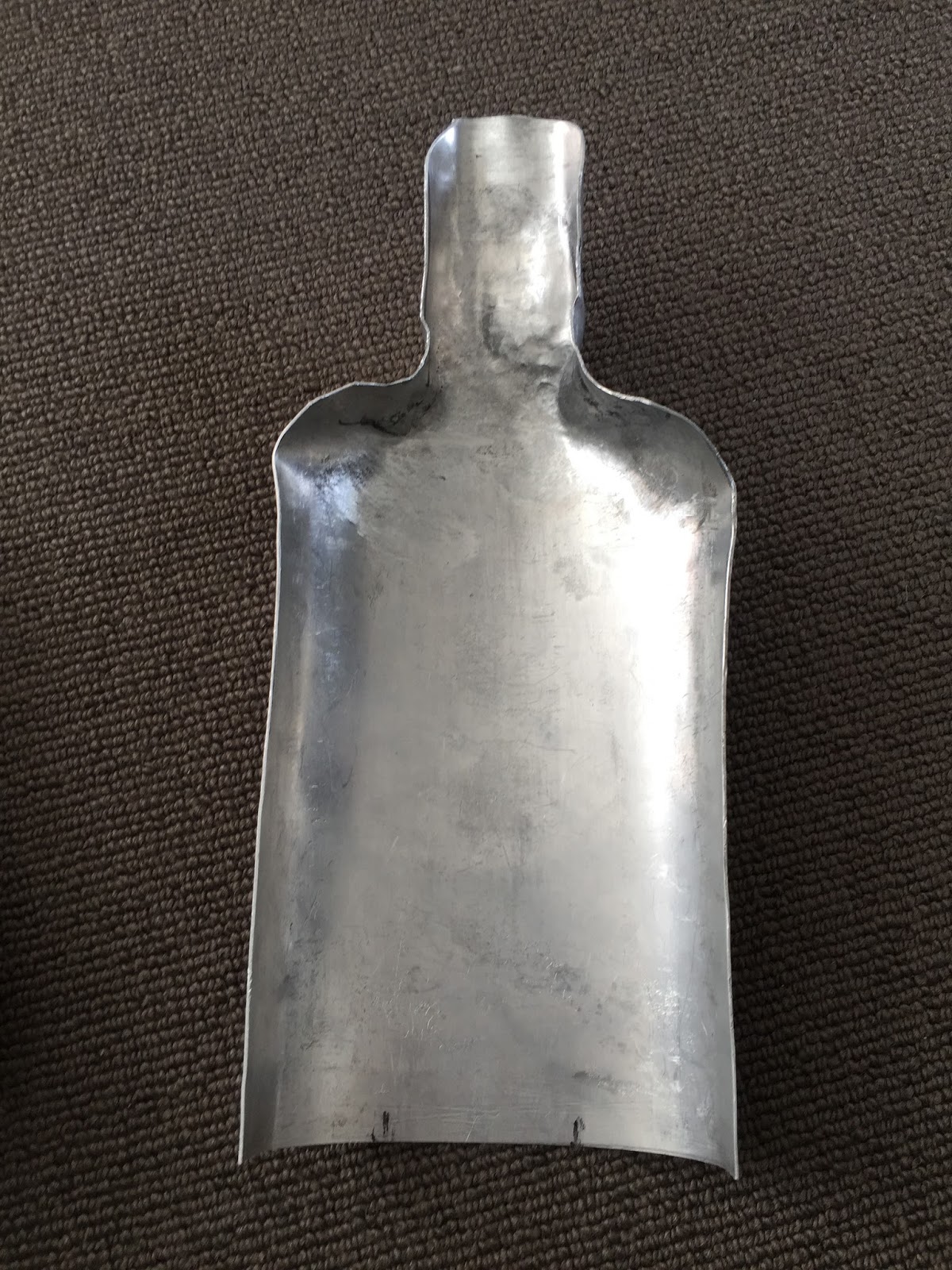
The result of the first one is unsatisfactory, the top op 
                     the lid area is exceeded and there is a big gap in the 'shoulder' part 


Result 2


                                      The second result is more desirable, the skin adhere
                                      closer to the contours of the template compares to
                                      the first result

Practice

                               Using the Guillotine to cut the aluminium sheet, here we are using 
                               the 1mm 5005 aluminium 


                               Once we got the desirable size, use the mark pen to roughly draw 
                               the shape of your model 
                              
                               THINK CAREFULLY if you don't want to waste your material!


                                          Cut off the irrelevant area by using this large shear


                               Use the aviation snip to modify the edge. Here are two types of
                               snips which are right-hand and left-hand, it is very important to
                               choose the right type which suits the curve you want


                               Use the slip rollers to curve the sheet as much as possible, the 
                               curve should be covered around the body of the model in order
                               to avoid a gap between your model and aluminium sheet 


Check the sheet with your model to see which area need to be modified


Use the T-Dolly to bend the edge
JUST BE PATIENT! 


The English Wheels can make the metal thinner and wide, it also smooths the skin